
May 4: Remembrance Day
On May 4, we commemorate the victims of World War II and the victims of conflicts and peacekeeping operations in which the Netherlands was involved after World War II. You are warmly invited to attend the commemorative ceremonies in Aalten, Dinxperlo, and Bredevoort.
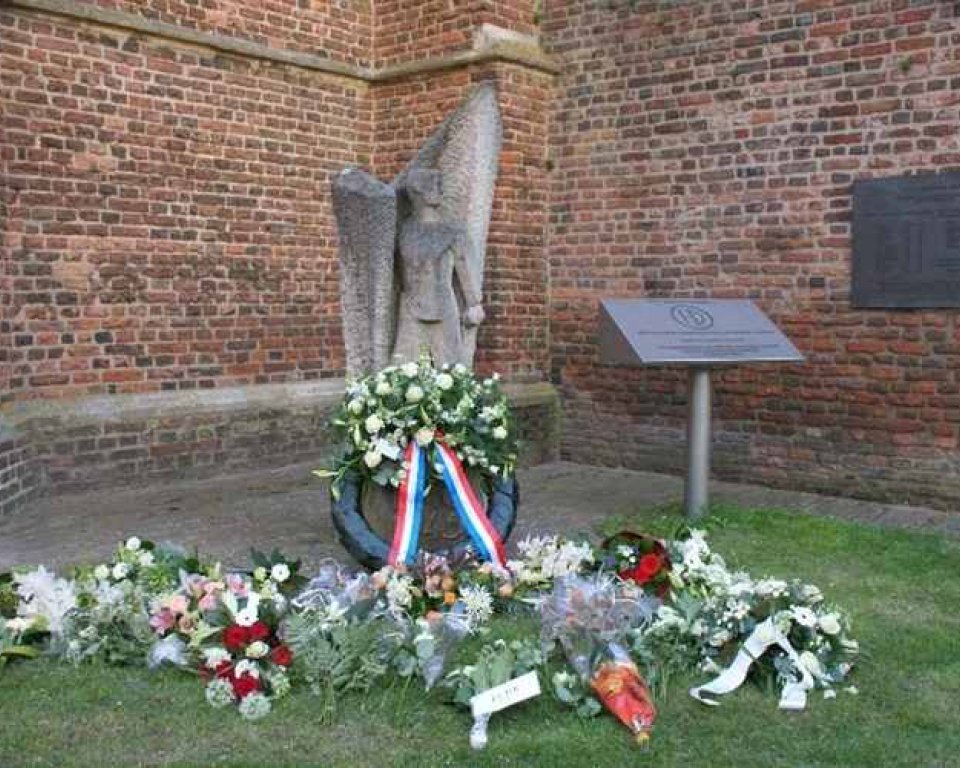
Remembrance Day Speech in Aalten, May 4, 2026
“Understanding history” is the theme proposed by the National May 4 and 5 Committee for today’s commemoration. Understanding history is no small task. Can we truly understand history? And certainly this history—the history of World War II, the history of the Holocaust. To understand history, you must first gather knowledge and let it sink in. We have been commemorating that war for 81 years, and our understanding of what happened before, during, and after the war has grown enormously over those years. As a result, we now think differently about the war and therefore commemorate it very differently than we did eighty years ago. But do we understand more and/or better than we did back then?
At first, the focus was primarily on commemorating the fallen members of the resistance, who had upheld our morality and honor during an immoral era when there was little honor to be found. Later, attention shifted more toward the perpetrators, the perpetrators of injustice, partly due to the trials against them and the hunt for fugitives. It was not until the 1960s that attention gradually turned to the victims. First, our Jewish fellow citizens who were excluded, stripped of their possessions, herded together, deported, and murdered right before our eyes. Later, the Roma and Sinti, our fellow human beings who were gay, and the several hundred thousand forced laborers. Those forced laborers were a complex group; after all, they had worked for the enemy, and at first they were largely ignored. It is no coincidence that it took eighty years before a monument was erected for the 50,000 men who were arrested and deported during the Rotterdam Razzia, including to Suderwick. Attention was also paid rather late to the few hundred thousand fellow citizens who, out of conviction or for profit, collaborated with the occupier—the collaborators. The image of a Netherlands full of victims and resistance heroes has thus shifted over the years. We had to acknowledge that, besides white, there was also a lot of black. And perhaps even more gray.
In recent years, much has been written about the government’s own involvement in oppression and persecution. Even before the war, the government had instructed senior civil servants to remain at their posts as much as possible so that social life could continue. And that worked quite well at first, but it became increasingly difficult as persecution and oppression intensified. By then, however, there was hardly any room left for genuine mass resistance.
To bring this into the present day, what would you do if you were a civil servant in Ukraine and part of your country was annexed by a violent occupier? Would you stay at your post, or would you resign? Would you stay in your country or flee? With or without your family? To understand history, you need to know the circumstances under which people had to make choices back then. Many did not know what was right, wise, and feasible, or shrank from the risks. Judging without knowledge does not do people justice. Caution, therefore, seems to me to be called for.
Understanding history is also essential to learning from it. Could the war have been prevented? What were the warning signs of the war? What signals were there, and why did they have so little impact on the collective consciousness—let alone prompt people to take a firm stand—with few exceptions?
As early as 1935, Johan Huizinga—then a popular and internationally respected historian—analyzed his own era. In his essay *In the Shadow of Tomorrow*, he writes: “We can see how almost everything that once seemed fixed and sacred has become unstable: truth and humanity, reason and justice.” Five years before the war, he dissects the culture and public opinion during the terrible crisis years and the rise of nationalism, populism, communism, fascism, and Nazism. If a party, a people, or a nation becomes the highest good and justice and morality must give way to it, then that is bound to lead to war, he explains. And yet the Western world had no answer to the violence and terror of the Nazis. And yet many ordinary people felt overwhelmed by what befell them. Are we any different? Do we have an answer to the war rhetoric of the moment, to nationalist delusions of grandeur, to xenophobia?
Understanding history also involves coming to terms with the war. How have we dealt with the suffering and injustice experienced by both victims and perpetrators? How have we dealt with our liberators, and with the violence that bevrijding that bevrijding ? Consider the indiscriminate bombings of German cities such as Dresden and Bocholt. How did we treat Germany and the Germans after the war, and how do we deal with their past now? Are Germans now welcome on May 4 to commemorate the immeasurable injustice of that time together with us? Or do we prefer to keep them at a distance and still look down on them a little?
A week ago, Edith Eger passed away at the age of 98. As a young Jewish woman, she barely survived her time in Auschwitz; American soldiers found her barely alive when they bevrijding the bevrijding. Camp doctor Mengele asked her to dance for him, and thus she earned the nickname “the ballerina of Auschwitz.” She emerged from the war damaged and bereft, but at a certain point she began studying psychology to understand and help herself and others. In her book *The Choice*, written when she was ninety, she describes her years-long healing process. She confronts history, including her own history of loss and injustice.
Every person and every community has a choice in how to deal with injustice that has befallen them or been inflicted upon them, she argues. Either let go and forgive to some extent, or allow the rest of your life to be controlled by that injustice and those who committed it. It is up to all of us to choose between living in freedom or remaining held hostage by our past.
“I never let the enemy kill my spirit,” said Edith Eger. Living through our history, understanding it, and learning from it—Edith Eger did just that. And you?