Pre-care home
What is it?
A pre-mantle care home is a precursor to the informal care home. In many cases there is talk of looking after each other and of light Health, but a real informal care situation has not yet arisen. Then the pre-mantle care home can offer a solution.
- The pre-mantle care home is a temporary home added to the main home.
- It can also be a portion of the main house that is set up as a separate residential unit.
The pre-mantelzorgwoning is fully accessible for all stages of life, and a temporary environmental permit is required for its installation. If issued, this permit is valid for a maximum period of 10 years.
The scheme is not intended for the addition of permanent living space, such as permanent house division, change of function, or rental.
How does it work?
The pre-mantelzorgwoning (pre-care home) is intended for residents who are at least of the statutory retirement age (currently 67) and who Health light Health within their own social network (often family). They also jointly declare that they will provide this Health when the need arises. From the state pension age onwards, no indication is required.
If care is provided to someone younger than the state pension age, we will arrange a customized solution and request a medical certificate. Examples include a family member with a progressive chronic illness or a child with a disability.
Rules for a pre-mantle care home
Pre-informal care homes are not exempt from planning permission. If the home complies with the regulations and is also permitted to be built, the municipality will grant a temporary environmental permit for 10 years. If the Health , the home may be converted into an informal care home during this 10-year period or immediately thereafter. The regulations for installing a pre-informal care home are set out in the policy rules for pre-informal care homes.
The (future) caregiver and the person being cared for have a long-term social relationship. The caregiver can live in the main residence and the care recipient in the pre-caregiving home, but the reverse is also possible. Think, for example, of family members such as parents and children. But it can also be a long-term friendship.
If the care situation is terminated by, for example, a move or death, the home must be removed within two months. If the pre-mantle care home is set up in the existing main dwelling, then its occupancy must cease. Because it is not a matter of "just" adding a dwelling, we make the placement of the pre-mantle care home conditional on the signing of a caregiver declaration. The future caregivers declare that they will provide this Health as soon as and for as long as it is needed. In it, all those involved (caregiver and caregiver) also indicate their consent to the pre-mantle care home.
What to do
You must apply for an environmental permit to construct a pre-mantle care home. You can do this through the environmental counter.
We recommend that you read through the policy rule and the care statement before applying.
Privacy
All information you provide to us is handled with care. Personal and/or address details will only be used for the purpose for which you provided them.
Statement Pre-mantle care home mutual care provision
Downloading and opening a document
You can open a PDF file in various PDF readers, such as Adobe Reader.
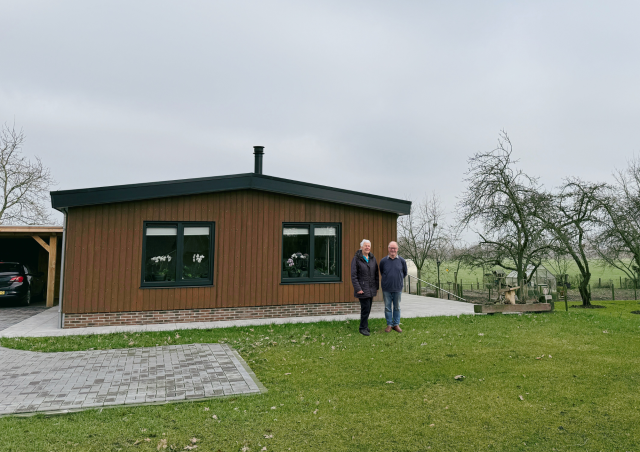
Mr. and Mrs. Luiten live in a pre-informal care home
Four generations under one roof thanks to a pre-built care home: “The family home stays alive”
Four generations living together, each with their own space but always close by. On the Vaags Luiten family’s property in Aalten, this has now become a reality. Mr. and Mrs. Luiten, both in their eighties, moved into a pre-retirement home on their own property. Their former house became the new home of their granddaughter, her husband, and their little daughter. And in the farmhouse on the property live Edwin Vaags and his wife, who moved in with her parents there after they got married. The result? Peace, bustle, and a property that’s ready for the future.
How it all began: a question many families can relate to
As in many families, the question eventually came up: how are we going to handle this in the future? Mr. and Mrs. Luiten had reached an age where downsizing seemed like the logical choice, but they preferred to stay in their familiar surroundings. “My father-in-law really wanted to keep living where he’d always lived: on his own property, with his own vegetable garden. Everything stays the same, just a little smaller,” says Edwin.
The idea of a pre-care home came their way through the grapevine. In November 2024, the first appointment was made with the municipality, and from that moment on, things moved quickly. By April 2025, the little house was already there. “The municipality cooperated very smoothly, and the contractor also knew exactly what needed to be done.”
A smooth process with the municipality
The application process turned out to be less complicated than expected. “It went 300% better than we expected,” says Edwin. “The municipality was very cooperative.” Since there was no official care request on paper, the application didn’t fall underInformal carebut under Informal care.” That made no difference to the procedure; the application process was the same, except that administrative fees (known as “leges costs”) were charged, which isn’t the case for informal care homes.
From plan to implementation
When building a home for informal caregivers, it’s essential to inform the neighbors, but fortunately, they responded enthusiastically. “Everyone is happy that Grandpa and Grandma can continue living in the neighborhood.
The construction of the small house went smoothly and efficiently. Thanks to the contractor, who knew exactly what was and wasn’t possible, the residents were well supported throughout the entire process. This resulted in a quick and smooth installation of the home, with the day itself being a real event: “They started at 6 a.m. and by noon the house was there!” The utilities were also well organized. The utilities were extended from the existing home to the new cottage, so there was no grid congestion and the residents didn’t have to worry about it.
A yard coming back to life
The pre-care home brings peace, warmth, and a sense of the future to the property. Mr. and Mrs. Luiten live independently in their new home, while their granddaughter has found a lovely place to live in their former home. For Edwin, it also feels like a form of reciprocity: “My in-laws have always taken care of our children; now we can give something back.” At the same time, Grandpa and Grandma’s move creates a sense of continuity: by downsizing to a smaller home on their own property, their house became available for the next generation. Or as Edwin puts it: “The property stays alive. Everything can continue as usual, but now with a new vibrancy.”
For other residents who are unsure whether an (early-stage) care home is right for them, Edwin has a clear message: “Definitely look into it. And if the opportunity arises: go for it! How wonderful it is to be able to keep your loved ones close.”