
Bike paths
In our municipality, we have many bicycle paths. Cycling is healthy and good for a clean and sustainable environment. Sometimes the bike lanes lie along roads and sometimes they are separate. If a bike lane is on the road, we call it a bike lane or bike lane.
We take care of our cyclists. With bicycle paths, road safety, driving comfort and the feeling of safety and overview play a major role. For each situation, we examine whether lighting contributes to this or not.
Types of bike lanes
We have both recreational and through bicycle routes. Both can be inside and outside built-up areas.
Recreational bicycle trails are used by our own residents and by tourists primarily during the day. These trails may be in sensitive areas with valuable flora and fauna. Lighting in these areas is quickly disruptive to the natural environment and can also provide false security.
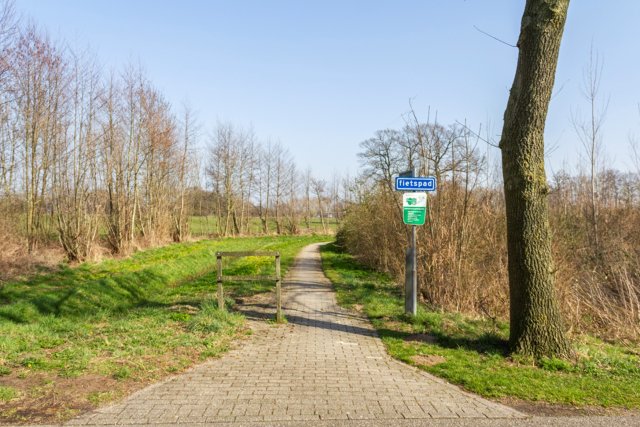
Through bicycle routes are routes used primarily by our own residents. Often these are daily routes. We also have main bicycle routes. These are main routes that run through the municipality and sometimes connect surrounding areas.
On some roads, the bike lane is next to the roadway, sometimes it is on the roadway, and sometimes it is a little further from the roadway. This helps determine traffic safety. When a bike lane is on the roadway, there is a greater chance of a conflict between a car and cyclists than when the bike lane is not on the roadway.
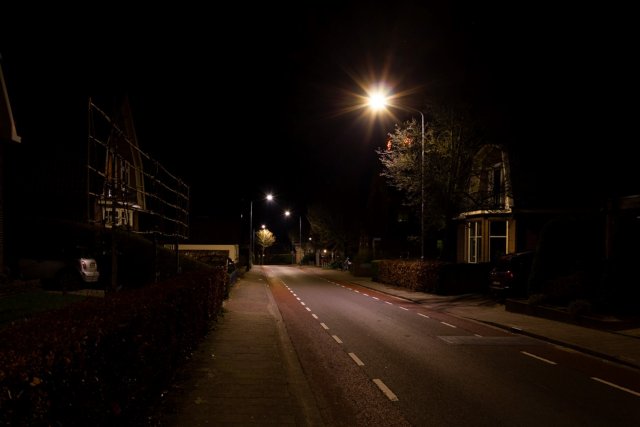
Direct and indirect lighting
Indirect lighting is lighting that shines from the road onto the bike path.
Direct lighting is when there is a light directly near the bike path.
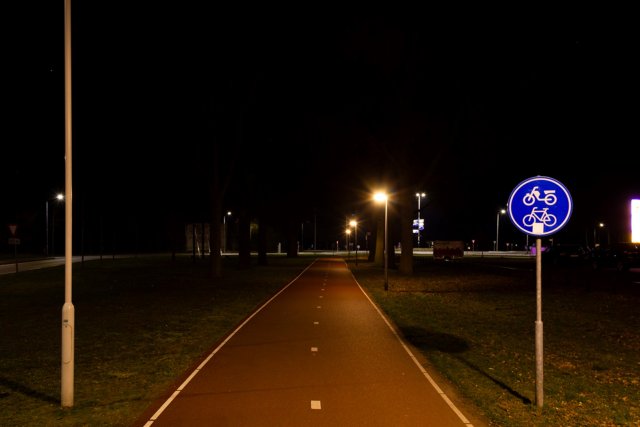
Traffic and social safety
Road safety is how we can get from A to B safely. Light can be a useful tool in this regard, but there are also alternatives. Think of markings, lighter road surfaces, reflection, etc. These are often more effective.
Social safety can be divided into an objective part (number of accidents, for example) and subjective part (feelings). The latter makes it tricky. Everyone experiences a situation differently.
Mock security
If a road is lit, but there is no direct social control, we speak of false safety. There is no one around to help if something happens. The light may give a sense of safety but it does not make the route safer.
Legislation
In the Netherlands, we are not obliged to light. We only have a duty of care regarding light poles. We have to maintain them properly.
This is how we do it from now on
- We do not illuminate recreational bicycle routes because they are primarily used during the day.
- We illuminate main bicycle routes (owned by the municipality) within built-up areas. This can be done by direct or indirect lighting. We dim the lights after 7 pm. For each situation we also examine whether the lighting can be turned off at night.
- We provide the main bicycle routes (owned by the municipality) outside built-up areas with alternatives instead of lighting, where necessary. If there is lighting now, it will not be replaced when replacement is needed.
- Other bicycle routes we do not light. This way we avoid false safety; a lit road without further social control.