
Advertising
In all our cores we do find advertising. It is also impossible to imagine our society without it. Stores, businesses, associations. Everyone uses advertising to show where they are located, to show what is on sale, to draw attention to something or for many other reasons.
An advertisement also often uses lighting to make it more noticeable. Until recently, billboards or posters were illuminated with a lamp. Now we increasingly see light boxes, usually with an LED bulb shining from the inside out. But also large displays and increasingly with flashing and moving images. In our municipality there are rules for being allowed to place advertisements.
Led displays
LED displays/LED screens and the like (now further referred to as LED displays) we see more and more. They are illuminated billboards and increasingly have moving and sometimes flashing images. Sometimes the upper part consists of text and the lower part an advertisement. The screens are visible from afar and because of the brightness of the light many people are bothered by them. Road safety can be compromised if road users are distracted or blinded by them.
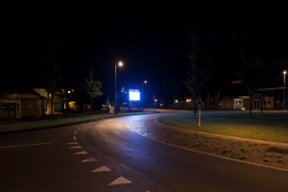
Advertising in bus shelters (abri's)
In bus shelters (abri's) we sometimes see illuminated advertisements. The light from a bus shelter can be bright and distracting.
In our municipality we do not have illuminated advertisements in bus shelters.
Illuminated shop windows
Store owners like to make their stores stand out and encourage residents to come and shop. Often the light from the shop windows shines onto the street making it seem dark there.
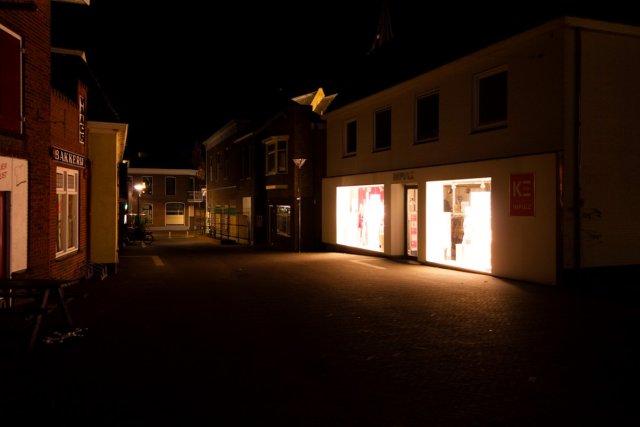
Increasingly, we are also seeing LED screens in store windows. These are on even when the store is closed.
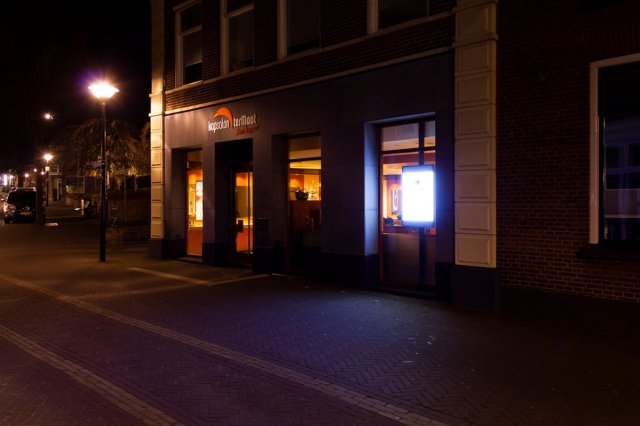
Advertisements of a company
Business owners like to show off their business. This can be done by illuminated nameplates on the facade or in front of the building. Sometimes these are so brightly lit that they are no longer legible after dark. Interestingly, many businesses are easier to find in the late evening or night than during the day. During the day their logo does not stand out, but in the dark all the more.
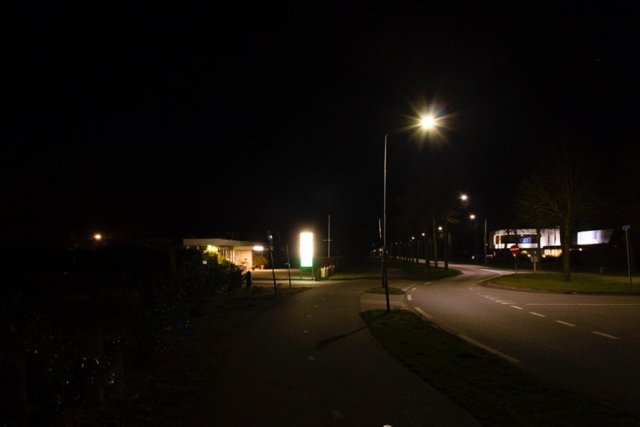
Advertising on lampposts
We do not have lighted advertising bins hanging from lampposts. For the municipality, it can be an additional source of revenue. But there are other sides to this advertising. Not everyone appreciates the brightly shining signs at evening and night because they cause light pollution. Energy use also raises questions.
Laws and regulations
Criteria for advertising are set out in the municipality's Welstandsnota. Advertising is only allowed in designated areas, but not, in principle, outside these areas. With regard to illuminated advertisements the following is stated: 'Advertisements in historic surroundings should preferably be illuminated; neon and light boxes should be judged on their brightness and color. In historic surroundings restrained color and brightness. Flashing or violently moving advertising is not permitted in rural surroundings.
Advertising in rural areas is in principle not permitted. Here the relationship between the advertising message and the activity is often lacking.'
The General Local Bye-Law (APV) defines in articles 117 and 118 that it is forbidden to make or carry commercial advertising on or to an immovable property by means of a lettering, announcement or image that endangers traffic or causes serious nuisance to the surrounding area (article 117, prohibition of annoying or dangerous advertising).
The permit for illuminated advertising may be refused if the advertising in itself or for the surrounding area does not comply with the welfare policy. A permit may also be refused to prevent nuisance to the surrounding area (e.g., light nuisance).
For LED displays, we are looking at several guidelines and publications:
- The Dutch Lighting Science Foundation (NSVV) guideline for the prevention of Light Nuisance.
- Rijkswaterstaat's handbook and the CROW publication "Advertising along roads.
- The Omgevingswet
- New, future guidelines applicable to LED displays
This is how we do it from now on
We are aware of the positive and negative effects of advertising and find that:
- local residents and traffic should not be hindered by advertising lighting;
- flora and fauna should not be disturbed by it;
- it should not clutter the landscape.
We are very cautious about LED displays. The Omgevingswet that no nuisance may be caused to the physical living environment. If an LED display is nevertheless permitted at a designated location, the municipality will in any case impose the following requirements:
- there should be no disturbance to the surroundings including flora and fauna;
- the display dims in the evening and is off at night;
- No flashing or moving (movie) images;
- road safety must not be compromised;
- To the colors, the municipality may impose requirements. This is situation dependent.
LED screens in shop windows should not radiate onto the street or cause nuisance to nearby residents. We ask business owners to dim the screens after 7 p.m. and turn them off after closing time.
We discuss with business owners to be cautious with illuminated billboards/stages, etc. By using focused or soft light, business owners can often achieve just as much or even more.