
Roads
In the Municipal Traffic and Transportation Plan, roads are divided into through roads, area connector roads and access roads.
Trunk roads are the provincial roads (N roads). These roads are intended for the reliable handling of relatively large volumes of traffic with a high average speed (80 to 100 km/h) and are located outside built-up areas. These roads are not managed by the municipality.
Area access roads often connect to county roads. They have both traffic flow and interchange goals inside and outside built-up areas).
Secondary access roads are roads whose main purpose is to "stay". These are can be located inside and outside built-up areas. Traffic does not have to travel long distances on these roads.
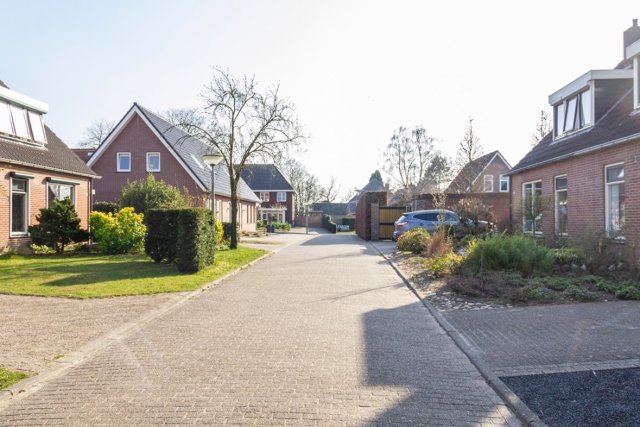
Traffic and social safety
We talk about road safety when we can travel from A to B safely. It is about the safe and smooth flow of traffic. Several factors affect traffic safety. How is the road laid out? Are there many obstacles? Are there many blind curves in it? Are there different road users?
Social safety can be objective or subjective safety. Objective social safety is measurable, such as the number of burglaries. Subjective social safety is the feeling of safety. This is different for everyone.
On area roads, road safety plays an important role. In neighborhoods and districts, it is social safety (sense of security). Social safety is a lot harder for us to deal with than road safety.
Laws and regulations
Various laws and guidelines apply to roads. With regard to lighting and roads, there is only one guideline, NPR13201-A1 (2020). This guideline contains advice on the luminous intensity on the road (horizontal luminous intensity) and the distribution of light on the road surface (uniformity). It also discusses the amount of light at a height of 1.5 m (vertical luminous intensity). Other light sources are also visible at this height, such as headlights, shop window lighting, light from homes, and so on.
Integral
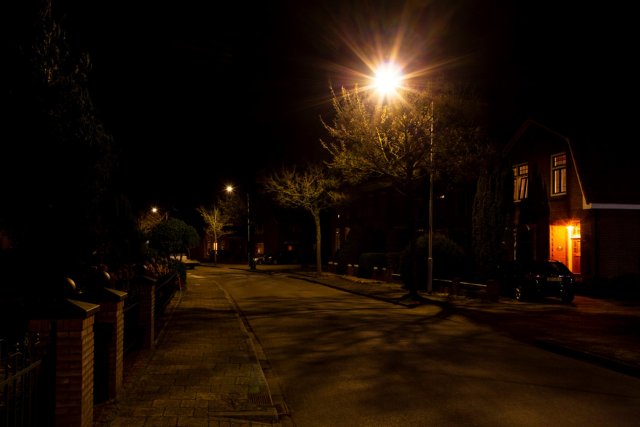
Along many roads there are public lights. Along the same roads are also trees. Trees grow taller. If there is a lamppost next to them, things often go wrong. By carefully considering the location and size of a tree as early as the design stage, there will soon be no lamppost on the street whose light is blocked by the tree. We call this integral design.
Techniques
When we dim lights, we can save energy. Dimming means making the light less bright. This is not really noticeable to road users. At several locations we have been dimming the lights in the evening and night for years with no complaints.
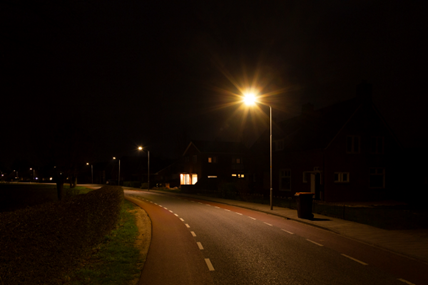
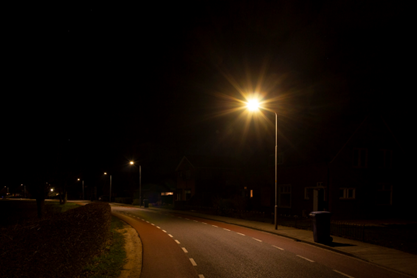
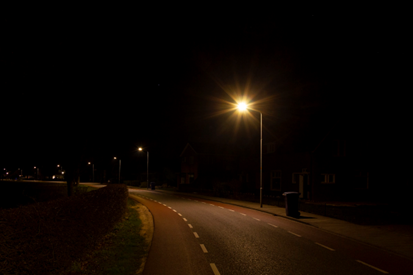
Another technique is detection. This is a system where the light is off or on at a low brightness by default. When someone approaches, the light comes on or comes on brighter. As soon as the person has passed, the light goes off again or turns on softer.
Do not illuminate unless
The principle of "Do not illuminate unless" is reflected in the steps below.
- Is road safety at risk?
- If so, could the road design be different?
- If not, can we apply passive marking?
- If not, can we use active marking?
- If not, we install energy-efficient lighting looking at what times and how much light is needed.
This is how we do it from now on
- For new situations and for reconstructions, the principle "Do not light unless" applies.
- Traffic safety determines the choice between having or not having lights if no good alternative is available.
- We light at no more than 75% of the guideline for luminous intensity. The uniformity is as good as possible (in existing situations depending on the distance between masts) on through roads and roads in the center area. We do not maintain a requirement for vertical light intensity.
- For each type of road and location, we consider how much light is desirable at what times.
- We dim the lights after 7 p.m.
- Detection we apply in locations where it makes sense.
- When we replace them, there will be no more light on the street than there is now, and we check whether the light is really necessary. We do this together with users and residents.
- We choose solutions that are the most sustainable, that save energy and reduce light pollution, when lighting does occur.
- If we expect larger changes, we will coordinate with users and local residents.
- We strive to minimize light pollution for road users and local residents.
- Lighting we design integrally.