
Residential area
The merger of the former municipalities of Aalten and Dinxperlo has resulted in clear differences in our residential areas. However, the date of construction, the composition of the population, and the location also determine the appearance of a residential area. The amount of lighting varies from one neighborhood to another. That is not a problem at all; it often suits the environment and our residents are used to it. Nevertheless, it is good to see if things can be done differently, less, or better.
At night, public lighting mainly determines the image on the street. Sometimes there is also lighting from outdoor lamps and in residents' gardens. In a residential area, functions such as living and playing come together. Public lighting can play an important role. But it is not just a role.
Light nuisance
We speak of light nuisance when a light source causes nuisance. This can be a lamppost shining into a home. Light nuisance also affects flora and fauna. For example, because light from sports field lighting shines into nature because it is incorrectly adjusted. This disrupts the life of plants and animals resulting in a change in the quality of life, disruption of biological rhythms, disorientation and attraction by light (with potentially fatal results for birds and insects, among others).
Laws and regulations
In the Netherlands, we are not obliged to install public lighting. However, we do have to maintain the lighting properly and the principle of liability applies: if the public lighting does not meet the requirements that road users are entitled to make of it, they can hold the municipality liable for injury and damage (Book 6 of the Civil Code, Article 6.162 ff. and Article 6.174). The liability principle relates only to the road safety function of public lighting.
Public Lighting Directive
We have the NPR13201/A1 in the Netherlands. It is not a law, but a recommendation/directive. We are also allowed to deviate from it. The guideline gives advice on:
- Amount of light on the street (horizontal luminosity). This depends on the location, type of road and how much traffic there is.
- Amount of light at 1.5 meters height (vertical light intensity). At this height, there is also light from shop windows, from headlights of cars and light from homes, for example. Therefore, this value is difficult to measure. Also, the value in the guideline is very high.
- Distribution of light on the road (evenness). The better the distribution is, the fewer black spots there are on the road and the better we can move to lower light levels. It also allows us to avoid the effect of light-dark light (sun between trees). In some locations, evenness is important for social safety, such as in shopping center areas and in residential areas. Or for traffic safety on through roads.
Police Hallmark Safe Housing
The Police Quality Mark Safe Living (PKVW) is a (voluntary) quality mark. It is often offered by property developers. It consists of several certificates. For example, there is the 'Secure Dwelling' certificate. This says something about the hardware and lighting around the house. This gives you a discount on insurance as a resident.
But there is also a 'Safe Environment' certificate. This says something about the level of light on the street and in back alleys. The certificates are separate. Without the 'Safe Environment' certificate, a discount on insurance premiums can still be given.
Atmosphere and livability
In residential areas, the living environment and atmosphere are important. Lighting can contribute to the livability and atmosphere in a residential area. If we use blue light, for example, the atmosphere will not be pleasant; it will feel cold and bleak. A residential area should feel pleasant. This benefits the livability of a neighborhood. However, many other factors determine the atmosphere and quality of life in our residential areas. Think of greenery, behavior, the amount of stone, and so on.
Traffic and social safety
We talk about road safety when we can travel from A to B safely. It is about the safe and smooth flow of traffic. There are many factors that affect road safety. How is the road laid out? Are there many obstacles? Are there many blind curves in it? Are there different road users?
Social safety can be objective or subjective safety. Objective social safety is measurable, such as the number of burglaries. Subjective social safety is the feeling of safety. This is different for everyone. It is a personal feeling and arises from the past, what happened, how well you know the area and so on.
In our residential areas, the emphasis is less on traffic safety than on a sense of security. No one wants to be burglarized. Public lighting cannot prevent burglaries. A lamp with a motion sensor on the façade works more effectively than a lamppost on the street.
Mock security
Many people report feeling safer when there is light. That's their feeling. But is it really safer? You can see someone coming down the road. But are there people nearby who can help if something happens? In other words, is there enough social control? If there is not, we speak of false security.
Color and face recognition
Light color determines social safety. Some orange lighting does not give good color and face recognition. Everything appears red/orange and the real colors cannot be seen. This can be seen in the pictures below. They are the same color trays. But the light color makes the trays appear red or orange on the second one.

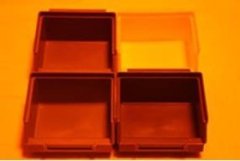
If something were to happen and you had to describe, for example, the color of the car a burglar drove away in, you would give a different color than the car actually had. If something were to happen and you had to describe, for example, the color of the car a burglar drove away in, you would give a different color than the car actually had.
Footpath and back path
Many footpaths that run between neighborhoods are used as walking routes during the day or to walk the dog in the evening. Often there is little or no social control in the late evening and night.
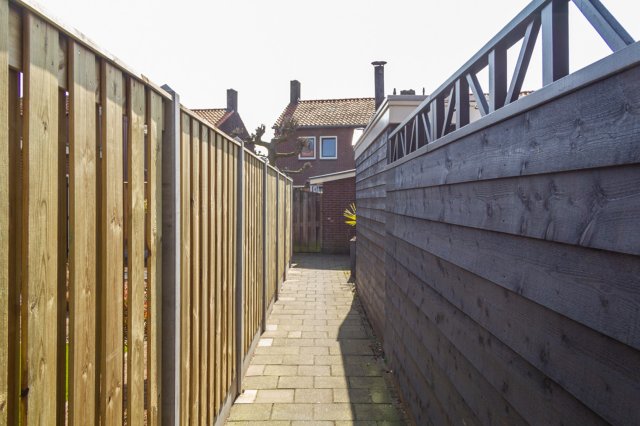
Back paths run behind houses. Often these back paths do not belong to us, but to third parties such as the housing association. They then determine whether or not the back paths are lit.
Parking lots
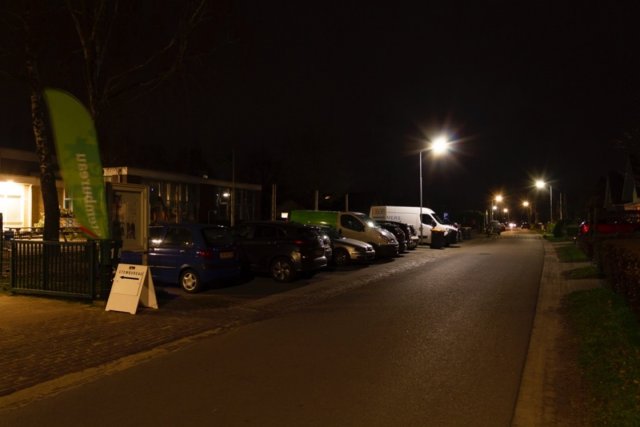
In our residential areas we have many parking lots. Some of these lots are heavily used and some are not. Often there are lights in these parking lots. This way, residents can see who is walking by the cars.
Integral
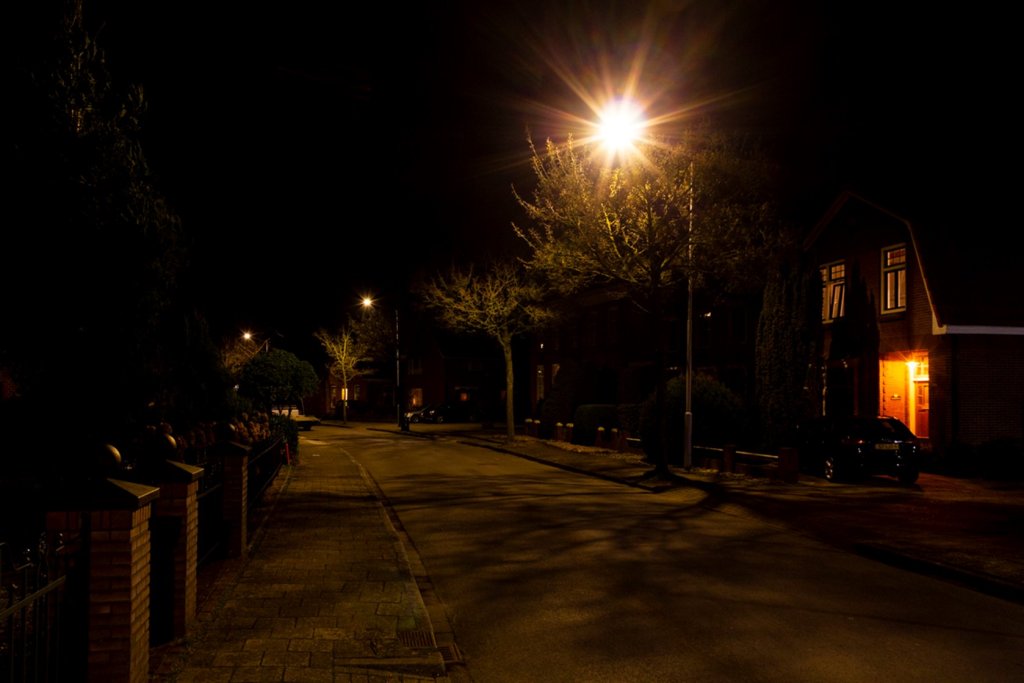
Greenery and lighting play an important role in our residential areas. Often over the years we see that a lamppost is completely among the greenery of the trees.
This is how we do it from now on
- The premise is that the atmosphere and livability in an area should be and remain good.
- We choose the right light color.
- Light pollution is avoided as much as possible.
- We dim lights after 7 p.m. and apply detection where appropriate.
- New lighting we can control remotely. We also see malfunctions remotely.
- We maintain a maximum of 75% of the current guideline (NPR13201/A1) for horizontal luminance. We do not maintain a vertical light intensity. The uniformity is as high as possible where the existing distance between lampposts is decisive.
- In residential areas where there is now a lot of lighting, there may be less lighting. For major changes, this is in consultation with residents.
- Sham safety is avoided by not lighting green spaces and parks, for example, unless it is a through route for which there is no other route and there are no alternative solutions.
- Loose footpaths (solitary footpaths) will be lit only when they are also part of a continuous walking route at night, there is no alternative route and there is enough social control.
- We do not light our back paths. If the backpaths are owned by third parties, for example housing corporations, they decide whether or not to light them. We do engage with these parties to see if their choice can be coordinated with ours.
- We do not maintain a Police Quality Mark Safe Living for public lighting as we do not maintain the guideline and do not light back alleys.
- Parking lots are lit only when they are used in the evening and at night. From the point of view of the environment, light pollution and the like, it may be decided to turn off the lighting in a parking lot that is not or hardly used during the dark hours.
- Larger changes involve the residents of the area in question.
- The design already takes into account the size of the tree in the future. Existing bottlenecks between landscaping and public lighting must be resolved. The basic principle here is that we do this at the lowest possible cost.
- As for light sources that do not belong to the municipality (for example, a tree that is lit), we will engage in discussions with these light owners.